St Sophia's Greek Orthodox Cathedral in Bayswater— Divine Wisdom and a wet October's afternoon

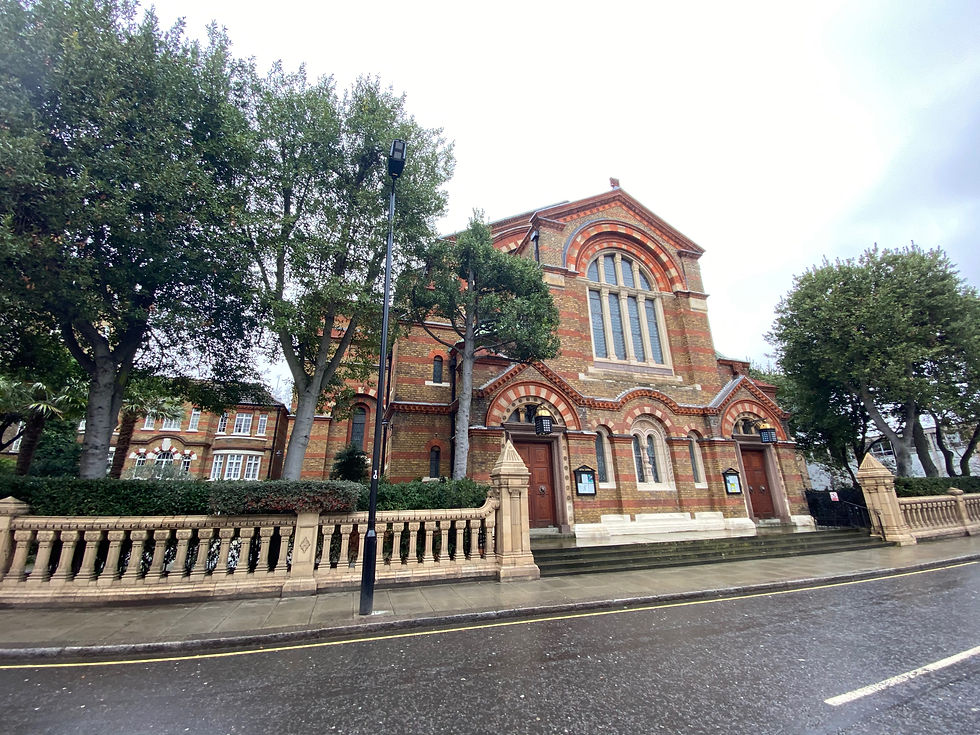
We visited St Sophia’s in mid-October 2026. Outside, Bayswater moved with its usual rhythm; traffic along Moscow Road, the slow drift of people towards Hyde Park. Inside, however, there was near silence. The cathedral was empty.
No congregation. No priest at the solea. Only Byzantine chanting, flowing gently from unseen speakers. The sound seemed to hover beneath the dome, unmoored from visible chanters, filling the vast interior with a liturgical presence that felt both ancient and strangely contemporary.
Standing alone in that space, it was impossible not to think about how and why this cathedral came to be.
From the City to Bayswater: A Community Expands
By 1870, the needs of the London Greek community had shifted dramatically. What had once been a merchant colony numbering in the hundreds had grown into several thousands. Families who had lived and traded close to the City gradually moved westwards to the emerging residential districts around Hyde Park, Bayswater and Holland Park. With this westward movement came a clear necessity: a larger, more monumental church that could serve the expanding Orthodox faithful.
At the Community’s General Assembly in January 1874, agreement was reached on the site, financing, and construction of a new Greek church in Bayswater. A Building Committee was formed under Emmanuel Mavrocordatos, alongside Constantine Ionidis, Sophocles Constantinidis, Petros Rodocanachi, Paraskevas Sechiaris and Dimitrios Schilizzi. A Finance Committee under Antonios Rallis oversaw expenditure and coordinated voluntary contributions from the community.
Architecture and Ambition
The committee sought expertise beyond its own ranks. They were assisted by the lawyer and distinguished Byzantinist Edward Freshfield, and appointed architect John Oldrid Scott to design the church in the Byzantine style, dedicated to the Divine Wisdom of God — St Sophia.
John Oldrid Scott, son of Sir George Gilbert Scott, was primarily known for Gothic ecclesiastical architecture. Yet here, in Bayswater, he turned towards Byzantium. His design consciously evoked the grandeur of Hagia Sophia in Constantinople, not as imitation, but as symbolic reference. The London Greek community was aligning itself architecturally with the spiritual heart of the Greek Orthodoxy.
The seriousness of the undertaking is evident in the extraordinary preparation: some 600 architectural plans and construction drawings were completed before the building contract was assigned to Messrs. Kirk and Randall of Woolwich in May 1877. Expenditure was meticulously studied; quantities and materials carefully calculated.
In June 1877, the foundations were marked out. On 18 July, the foundation stone was laid by Eustratios Rallis, a respected elder of the London Greek community. The silver trowel used in that ceremony is still preserved in the sacristy — a small but potent object linking present to origin.
The first liturgy was celebrated on 1 June 1879, on the Feast of Pentecost, by Archimandrite Fr. Hieronymos Myriantheus. The church was formally consecrated on 5 February 1882 by Archbishop Antonios Hariatis of Corfu.
By then, the cathedral was already more than a building. It was the architectural embodiment of a diasporic community’s confidence.

An Empty Cathedral, A Living Memory
All of this history seemed to gather beneath the dome as we stood there in October 2026.
The mosaics shimmered softly in filtered afternoon light. Saints and prophets gazed outward in timeless stillness. The chandeliers hung unmoving. And still, the chanting continued — detached from bodies, yet filling the volume of the nave.
The emptiness heightened awareness of scale and intention. This was never meant to be a modest chapel. It was conceived as a monumental declaration: that Greek Orthodoxy had taken root in London not temporarily, but enduringly.
And yet, on an ordinary weekday afternoon, it felt almost sacred — a sacred architecture awaiting its people.
For Greekscapes, this moment carried particular resonance. Diasporic heritage is not only experienced during feast days and crowded liturgies. It also resides in quiet intervals. In spaces that hold memory even when unoccupied. The cathedral has witnessed over a century of baptisms, marriages, funerals, national commemorations and moments of crisis. It has absorbed the anxieties and hopes of successive migrant generations.
On that October visit, what we encountered was continuity without spectacle.
We stepped back outside into the London street. Traffic resumed, the drizzle returned lightly, and the city folded us back into its movement. But inside St Sophia’s, Divine Wisdom voiced through distant chant; continued, steady and unbroken, as it has since 1879.


Comments